


Practical reflections from a Therapist with ADHD
As a trainee psychologist, the doctoral programme and my professional role have provided opportunities to deepen my understanding of ADHD. The reflections within this blog post represent my own personal experience of ADHD and the strategies that I have found helpful, rather than professional recommendations.

The power of labels
Labels can impact us in unexpected ways, especially when they are self-blaming or stigmatising in nature. For many people with ADHD, cycles of self-blame can be established through labels such as “lazy”, “unmotivated” or “too much” being used, either by other people or in our own internal self-talk.
Understanding the science behind ADHD, namely that it is neurodevelopmental and results in differences in executive function (such as initiation, planning, working memory, attention), can reduce the power of those labels. For me, this understanding allowed for self-compassion and forgiveness, creating a shift in self-blaming thoughts such as “I am so lazy, everyone else can just get things done” to more practical and optimistic thoughts, “What can I do to support myself”. Over the years I have tried different strategies to overcome these challenges, here is what I learned:
Managing and maintaining focus
For people with ADHD, it can be extremely difficult to initiate a task, especially when it is perceived as menial or uninteresting. Once that task has been started, shifting or interrupting focus unexpectedly can then require a ‘restart’ of that process, leading to sudden emotions such as anger or frustration. However, when subjects or activities are of significant interest, or if there is an impending deadline, attention can be so strong that it can lead to hyperfocus.
Hyperfocus, sometimes referred to as a ‘superpower’ of ADHD, is a prolonged period of deep productivity that can occur often at the expense of basic needs. Although hyperfocus can be very helpful for productivity – it is both mentally and physically exhausting. There are several practical strategies which I find helpful in ensuring a balance between maintaining sufficient focus and preventing a deep hyperfocus:
Time blocking/chunking
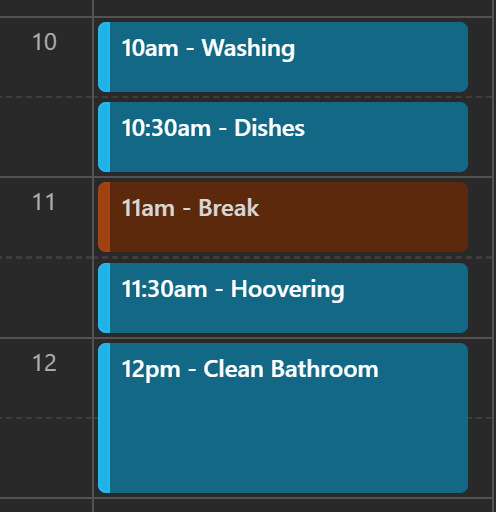
Time blocking (or chunking) involves planning out the day, including breaks, with each task having a set amount of time. Although suggesting additional planning may appear counter-intuitive, this method creates mini deadlines that provide structure, realistic goals and increases attention. Crucially, this approach also sets expectations of when focus will need to shift to another task, reducing unpredictability and the initial friction of initiating the next task. For example, instead of blocking out an entire day for “housework”, I may chunk the day into smaller subtasks.
Subtasks
By breaking bigger tasks down into smaller subtasks, the tasks become more manageable and realistic, therefore reducing the potential for overwhelm. I find that this small cognitive change has a big impact on managing my ADHD, as it recognises that progress can still be made even if not all tasks are completed. Combining time blocking & creating subtasks, a planner may look like this:
Apps that block distractions
Sometimes time blocking and subtasks are not enough. When completing tasks that require extensive periods of focus, minor distractions can cause shifts in attention towards irrelevant topics and activities, or loss of focus altogether. There are apps available that can block different categories of apps and websites for set periods of time, to prevent these unintentional shifts away from the planned task. These apps are available on both computers and smartphones, for example Opal and Freedom. Blocking apps can be particularly helpful during work hours or periods of study, as they break the impulsive habit of opening social media and prevent distractions caused by notifications.
Social media
It can be easy to fall into a habit of unlocking your phone and ‘doomscrolling’. There is one other simple change which I have found to be extremely effective - moving all social media apps to the third ‘page’ of my smartphone. Opening social media therefore requires an intentional scroll to find the app, rather than out of habit.
Pause strategies - taking a mindful step back
There are times when it is necessary to pause and take a ‘step back’ before reacting, which is particularly important when considering impulsivity and emotional reactivity. Emotional responses to situations, experiences, or indeed minor inconveniences, can sometimes be sudden and disproportionate in ADHD. This can lead to impulsive or emotion-led decision making with an urge to react immediately, without allowing sufficient time to consider the logical and contextual factors.
In these circumstances, I have learned to take a step back from the situation for at least 5 minutes to introduce a pause, allowing my emotions to regulate and contextual processing to occur. How this looks differs from person to person based on their preferences – it could be a physical-based pause, such as going outside or sitting away from a work desk, or a mental pause that can be achieved through guided relaxation and grounding techniques (which you can learn more about in this blog post by Dr. Stephanie Holmes).
Acceptance
ADHD is often stigmatised and misunderstood in wider society, which often makes acceptance more challenging. Acceptance does, however, create space to reflect honestly upon the ways in which it impacts your life. There is no shame in using apps to manage time, strategies to initiative tasks, emotion regulation techniques or reminders to aid memory. These are supportive strategies which will work best if adopted without self-blame or judgement.
In my experience, acceptance was achieved through exploring with curiosity – taking a balanced view which considers not only the challenges, but also the opportunities of ADHD. For me, these opportunities include being able to consider multiple perspectives at once, thinking of unique solutions and having a naturally creative mind. ADHD forms a part of who I am – and I wouldn’t want to change that.
- Tom Sadler